Redevelopment has become an important part of Mumbai’s residential property market. Old housing societies, ageing buildings and underused plots are being replaced by modern towers with improved layouts, parking, elevators, security systems and lifestyle amenities.
For buyers looking to Buy Properties in Mumbai, redevelopment projects can offer new homes in established locations such as Khar, Bandra, Santacruz, Andheri, Vile Parle and other well-connected neighbourhoods.
However, buying a redevelopment property is different from booking a home in a regular new development. The project may involve an existing housing society, old title documents, rehabilitation obligations, temporary accommodation arrangements, development rights and approvals that are issued in stages.
That does not mean redevelopment flats are unsafe. It means buyers must complete detailed verification before paying a booking amount or signing an Agreement for Sale.
This guide explains what to check before buying a flat in a redevelopment project in Mumbai.
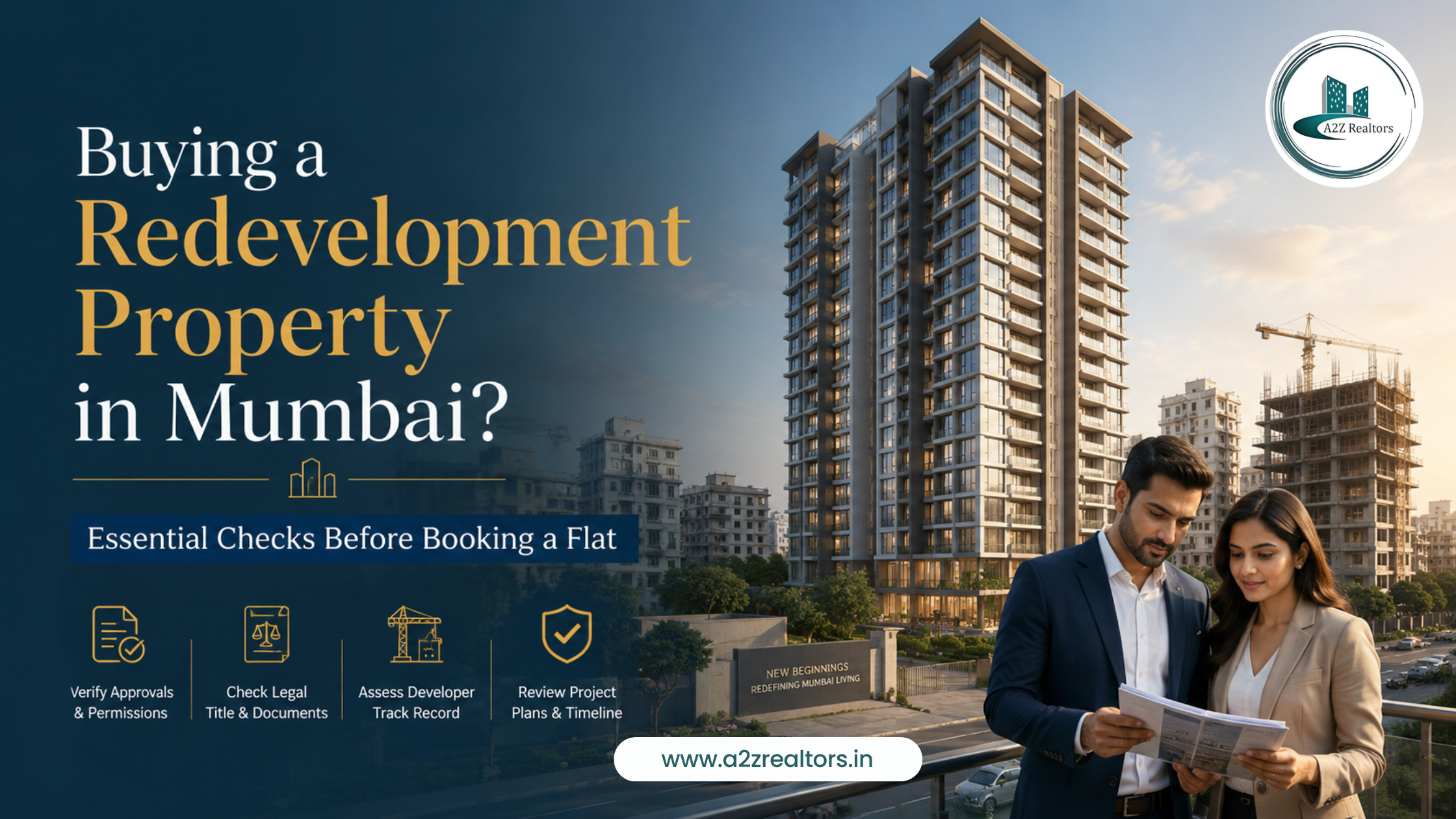
Direct answer: Before booking a redevelopment flat in Mumbai, verify the MahaRERA registration, developer’s authority to sell, society redevelopment documents, land title, sanctioned plans, Commencement Certificate, carpet area, possession date, total cost and litigation status. Hire an independent property lawyer before making a major payment.
Table of Contents
- What is a redevelopment property?
- Is it safe to buy a redevelopment flat?
- Redevelopment property buying checklist
- How to verify a project on MahaRERA
- Legal documents buyers should check
- Builder credibility and financial capacity
- Carpet area, approvals and possession
- Taxes, hidden charges and total cost
- Common mistakes and warning signs
- Questions to ask before booking
- Frequently asked questions
What Is a Redevelopment Property in Mumbai?
A redevelopment property is created when an old building, housing society, landlord-owned property, MHADA layout, cessed building or other existing development is demolished and reconstructed.
In a typical society redevelopment project, the developer provides replacement homes to the existing members. In return, the developer receives the right to construct and sell additional apartments in the open market.
The apartments sold to new buyers are commonly called the free-sale component.
Therefore, a redevelopment project often has two broad parts:
| Component | Purpose | Occupants |
|---|---|---|
| Rehabilitation component | Rehouses existing members or eligible occupants | Existing society members or tenants |
| Free-sale component | Generates revenue for the developer | New homebuyers |
As a new buyer, you are usually purchasing a flat from the free-sale component. You must verify that the developer has clear and continuing authority to sell that particular apartment.
Redevelopment creates a three-way relationship involving the society or landowner, the developer and the new purchasers. A weakness in the society’s title, redevelopment resolution or development agreement can affect the developer’s rights and, ultimately, the buyer’s transaction.
Is It Safe to Buy a Flat in a Redevelopment Project?
Yes, it can be safe to buy a redevelopment flat when the project has:
- A clear and marketable land title
- A valid and registered Development Agreement
- Proper society approval
- Active MahaRERA registration
- Approved building plans
- A valid Commencement Certificate for the relevant work
- A financially capable developer
- A registered and buyer-friendly Agreement for Sale
- Realistic construction and possession schedules
MahaRERA registration is important, but it should not be treated as a complete legal guarantee. Registration provides disclosures and regulatory protection, while title verification and contract review still require independent due diligence.
Redevelopment Property Buying Checklist in Mumbai
Use this summary before considering any redevelopment flats for sale in Mumbai.
| Check | What the buyer should verify |
|---|---|
| MahaRERA registration | Registration number, active status, phase, complaints and completion date |
| Developer’s selling rights | Development Agreement, Power of Attorney and free-sale entitlement |
| Society approval | Valid redevelopment resolution and appointment of developer |
| Land title | Property Card, conveyance or lease deed and title history |
| Encumbrances | Mortgages, charges, claims and lender permissions |
| Municipal approvals | IOD, sanctioned plans and Commencement Certificate |
| Flat approval | Wing, floor, unit number and layout in approved plans |
| Carpet area | RERA carpet area in all documents |
| Possession date | Agreement date compared with MahaRERA date |
| Developer history | Completed redevelopment projects and Occupancy Certificates |
| Total purchase cost | Price, GST, stamp duty, registration, parking and other charges |
| Agreement terms | Payment schedule, delay remedy, cancellation and refund clauses |
| Bank finance | Project loan eligibility and lender conditions |
| Final possession | Occupancy Certificate, utilities and handover documents |
1. Check the Project on the Official MahaRERA Portal
The first step in property due diligence in Mumbai is to find the exact project on the official MahaRERA portal.
Do not rely only on the registration number printed in a brochure. Search for the project independently and match the information with the property being offered.
Check the following information
- Project name
- MahaRERA registration number
- Name of the promoter
- Project address
- Survey, plot or CTS number
- Registered project phase
- Approved building or wing
- Declared carpet area
- Proposed completion date
- Revised completion date, if any
- Quarterly construction updates
- Approvals received and pending
- Encumbrance declarations
- Complaints and regulatory orders
- Lapsed, revoked, deregistered or abeyance status
MahaRERA itself advises buyers to match the CTS or survey details, address, unit number, carpet area and possession date, and to review complaints against the project.
Promoters are also required to update project status, bookings and approvals periodically. Therefore, do not check the registration only once. Review the latest updates before each major payment.
Important project-status warning
Avoid making a quick payment when the project is shown as:
- Lapsed
- Revoked
- Deregistered
- Under abeyance
- Under insolvency proceedings
- Non-compliant with quarterly updates
MahaRERA maintains separate lists for lapsed, deregistered and other affected projects. In some cases, projects kept in abeyance may face restrictions on bank accounts or further transactions until compliance is restored.
2. Confirm That the Developer Can Legally Sell the Flat
This is one of the most important legal checks before buying a flat in Mumbai.
The developer may not own the land. Its right to build and sell may come from a contract with the society, landlord or other landowner.
Ask your lawyer to examine:
- Registered Development Agreement
- Supplemental Development Agreements
- Irrevocable Power of Attorney
- Society resolution appointing the developer
- Tender or developer-selection records
- Rights granted over additional FSI or TDR
- Developer’s entitlement to the free-sale area
- Restrictions on sale, mortgage or assignment
- Conditions for termination of the developer
- Existing disputes between the society and developer
The Development Agreement should clearly state how much area is allocated to existing members and how much area the developer may retain and sell. It should also address timelines, parking, compensation, default and dispute resolution.
Practical check
Ask the developer to show where your proposed flat appears in:
- The sanctioned building plan
- The MahaRERA inventory
- The developer’s free-sale entitlement
- The draft Agreement for Sale
The unit number, floor, wing, area and use must match across all four.
3. Verify the Society’s Redevelopment Approval
In society redevelopment projects in Mumbai, the appointment of the developer must follow the applicable cooperative housing society procedure.
Buyers should ask whether:
- A valid Special General Body Meeting was held
- The redevelopment decision was properly recorded
- The developer was validly appointed
- The meeting had the required quorum
- The required member approval was obtained
- The minutes were signed and maintained
- The Development Agreement was authorised and registered
- Major disputes from dissenting members are pending
The Maharashtra redevelopment procedure discussed by legal professionals includes a Special General Body Meeting with the developer being appointed by at least 51% of the total society members, subject to the applicable process and documents.
A buyer does not need to personally manage society redevelopment procedures. However, your lawyer should confirm that no serious procedural defect could affect the developer’s authority.
4. Conduct Independent Title Due Diligence
A MahaRERA certificate does not replace a title investigation.
Ask an independent property lawyer to review the ownership history and confirm whether the land has a clear, marketable and transferable title.
Documents to check in a redevelopment project in Mumbai
- Property Card
- Conveyance Deed or deemed conveyance order
- Lease Deed, where the land is leasehold
- Earlier sale, assignment or transfer documents
- Development Agreement
- Power of Attorney
- Index II records
- Mutation entries
- Society registration certificate
- Approved layout
- Title certificate
- Legal search report
- Property tax records
- Details of pending acquisition or reservation
- Mortgage and lender documents
- Court proceedings affecting the property
Mumbai property structures may include freehold land, leasehold land, society-owned plots, MHADA layouts, SRA schemes and landlord-owned properties. Each category requires different checks.
Use official land-record services to verify the Property Card and CTS details. The Maharashtra Mahabhumi portal provides access to Property Cards, mutation records and related land information.
5. Check Mortgages, Charges and Lender Permissions
Redevelopment projects often require construction finance. A mortgage does not automatically make a project unsafe, but the buyer must understand:
- Which land or development rights are mortgaged
- Whether the proposed flat is covered by the charge
- Whether the lender has approved sales
- Whether a flat-specific lender NOC is required
- When the charge over the purchased unit will be released
- Whether project collections are routed through the declared account
A public CERSAI search may help identify registered security interests over an immovable asset. However, it should support not replace, a full title and lender-document review by a lawyer.
Under RERA, 70% of amounts collected from allottees must be deposited in a separate project account and used for land and construction costs, with withdrawals linked to certified progress.
6. Verify All Required Project Approvals
Do not accept the phrase “all approvals are in place” without asking for copies.
Common approvals include
- Intimation of Disapproval, where applicable
- Sanctioned building plans
- Commencement Certificate
- Amended plan approvals
- Fire approval
- Environmental clearance, where applicable
- Airport or height clearance, where applicable
- Tree authority permissions, where required
- Utility permissions
- Occupancy Certificate at completion
The BMC approval process includes scrutiny of plans, issuance of the IOD, Commencement Certificate and later acceptance of completion documents or grant of occupation permission.
Why the Commencement Certificate needs close review
A Commencement Certificate may initially permit construction only up to a certain level. Ask whether the certificate covers:
- The full building
- Only the plinth
- A limited number of floors
- The specific wing and floor of your flat
A brochure may show the final tower, while current approval may cover only an earlier construction stage. Your payment schedule should reflect actual approvals and construction progress.
BMC states that building-proposal approvals from 2016 onward are processed through its online system and can be searched through the relevant citizen services.
7. Review the Developer’s Track Record
Knowing how to verify builder track record before buying a flat is especially important in redevelopment.
Check:
- Number of completed redevelopment projects
- Whether completed projects received an Occupancy Certificate
- Actual delivery dates compared with promised dates
- Pending and completed MahaRERA complaints
- Consumer, civil and criminal litigation
- Insolvency or bankruptcy proceedings
- Construction quality
- Rent-payment disputes with old members
- Financial capacity to complete rehabilitation and free-sale work
- Maintenance and defect support after possession
Visit at least one completed project and one active construction site.
Speak separately with:
- Existing society members
- Buyers in earlier projects
- Building management staff
- Nearby property professionals
Do not rely only on testimonials selected by the sales team.
The RERA registration documents also require disclosures about projects launched by the promoter during the previous five years, including status, delays and pending cases.
8. Understand the Link Between Rehabilitation and Free-Sale Construction
This is a redevelopment-specific risk that many general property guides overlook.
Ask:
- Have all existing members vacated?
- Has demolition been completed?
- Are any occupants refusing to vacate?
- Is transit rent being paid regularly?
- Is rehabilitation construction separate from the free-sale wing?
- Does the project require rehabilitation milestones before further sale construction?
- Are there disputes over additional area, parking or compensation?
- Are existing occupants challenging approved plans?
A conflict involving existing members may affect access, demolition, financing, approvals or construction sequencing.
The sale flat may be legally distinct from the rehabilitation entitlement, but both components can still depend on the same land, approvals, developer and construction programme.
9. Verify the RERA Carpet Area
Do not compare homes only by the number of bedrooms or the “saleable area.”
Under RERA, carpet area broadly refers to the net usable floor area of the apartment, excluding external walls, service shafts, exclusive balcony or verandah and exclusive open terrace, while including internal partition walls.
How to verify carpet area before booking a flat
Compare the carpet area shown in:
- MahaRERA registration
- Sanctioned plan
- Floor plan
- Cost sheet
- Booking form
- Allotment letter
- Agreement for Sale
Ask for a room-wise dimension plan. Check columns, ducts, passages, internal walls and furniture placement.
The RERA registration filing must disclose the type and carpet area of apartments offered for sale, with balcony, verandah and terrace areas disclosed separately.
Expert tip
Compare the total agreement price per square foot of RERA carpet area, not a vague built-up or saleable figure.
10. Compare the Possession Date Across Every Document
When checking an under-construction redevelopment project in Mumbai, you may see several dates:
- Salesperson’s estimated date
- Brochure possession date
- MahaRERA completion date
- Revised MahaRERA date
- Agreement for Sale possession date
- Internal construction target
Your legal commitment should be based on the registered Agreement for Sale and applicable regulatory disclosures, not an oral estimate.
Ask for:
- A specific possession date
- A clearly defined grace period
- Conditions for claiming an extension
- Interest or refund rights after delay
- Treatment of force majeure
- Confirmation that possession will be offered with the required Occupancy Certificate
Under Section 18 of RERA, where the promoter cannot hand over possession according to the Agreement for Sale, an allottee may have rights relating to refund, interest or compensation, depending on whether the allottee exits or remains in the project.
11. Examine the Agreement for Sale Before Paying a Large Amount
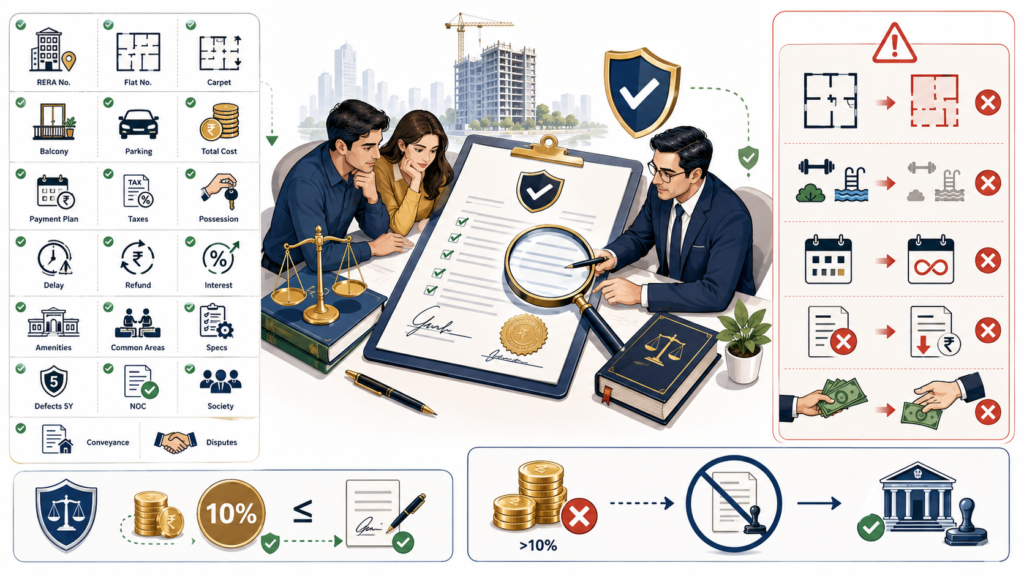
Never sign a standard draft without an independent legal review.
Under Section 13 of RERA, a promoter cannot accept more than 10% of the apartment cost as an advance or application fee without first entering into and registering a written Agreement for Sale.
Your agreement should clearly mention
- Correct project and MahaRERA number
- Flat, floor and wing number
- RERA carpet area
- Balcony or terrace area
- Parking rights
- Total consideration
- Construction-linked payment plan
- Taxes and additional charges
- Possession date
- Grace period
- Delay compensation
- Cancellation terms
- Refund deductions
- Interest on payment default
- Approved amenities
- Common areas
- Specifications and fixtures
- Defect-liability obligations
- Mortgage release or lender NOC
- Society or association formation
- Conveyance obligations
- Dispute-resolution process
RERA also provides a five-year responsibility for notified structural or workmanship defects after possession, with rectification obligations subject to the Act.
Avoid one-sided clauses
Be cautious where the agreement allows the promoter to change the layout, reduce amenities, extend possession indefinitely or cancel the allotment while imposing heavy deductions.
12. Calculate the Full Cost of Buying the Flat
The advertised price is rarely the final amount payable.
Ask for a complete written cost sheet covering
- Basic agreement value
- Floor-rise charges
- Preferential location charges
- Parking charges
- Clubhouse or amenity charges
- Infrastructure charges
- Legal and documentation charges
- Advance maintenance
- Maintenance deposit
- Corpus contribution
- Electricity and water deposits
- GST, where applicable
- Stamp duty
- Registration charges
- Brokerage, if applicable
- Loan-processing and valuation fees
GST on redevelopment flats in Mumbai
Under the current central GST framework, qualifying under-construction residential properties outside the affordable category generally attract an effective GST rate of 5%. Eligible affordable housing is generally taxed at 1%, subject to the prescribed area and value conditions.
A sale for which the entire consideration is received after the completion certificate or first occupation, whichever is earlier, is treated differently under the construction-service provisions. Obtain transaction-specific advice from a chartered accountant before relying on a tax estimate.
Stamp duty on redevelopment property in Mumbai
Stamp duty and registration charges depend on the instrument, market value, buyer eligibility and government rules applicable on the registration date.
Use the official IGR Maharashtra stamp-duty and valuation services. Do not rely only on an old online article or salesperson’s calculation.
13. Do Not Treat Bank Approval as Complete Due Diligence
Bank-approved redevelopment projects in Mumbai may be easier to finance. However, a bank’s approval is mainly connected with its own lending decision.
It does not necessarily confirm that:
- Every buyer-specific clause is fair
- The exact flat is free from all issues
- The possession estimate is realistic
- No society dispute exists
- The cost sheet is complete
- The layout is suitable for your family
- The developer will never face financial difficulty
Obtain a written loan sanction and review all disbursement conditions. Avoid agreeing to loan disbursements that are disconnected from construction milestones.
14. Complete Location Due Diligence in Khar
When buying a redevelopment property in Khar, examine more than the pin code.
Visit the site during different times of the day and check:
- Width of the approach road
- Actual vehicle access
- Traffic and noise levels
- Distance from the railway station
- Connectivity to SV Road, Linking Road and major business areas
- Nearby construction activity
- Natural light and ventilation
- View from the selected floor
- Parking entry and turning space
- Water and drainage arrangements
- Fire-tender access
- Nearby schools, hospitals and daily services
- Proposed road widening or public reservation
- Monsoon conditions around the plot
Also confirm that the address, CTS number and ward details in the legal documents match the Khar property shown to you.
A Practical Redevelopment Buying Example
Suppose a buyer is offered a 3 BHK redevelopment apartment in Khar with possession in two years.
The project brochure shows a 1,100 sq. ft. carpet area and a premium amenity deck. However, the buyer discovers that:
- MahaRERA lists 1,045 sq. ft.
- The Commencement Certificate currently covers fewer floors
- The possession date on MahaRERA is six months later than the brochure
- Parking is not clearly identified
- The cost sheet excludes advance maintenance and legal charges
- The society and developer have a pending dispute about additional parking
None of these points alone automatically proves that the project is bad. However, they must be clarified and corrected in writing before booking.
This is the purpose of a redevelopment property buying checklist: it turns marketing claims into verifiable facts.
Common Mistakes Buyers Make
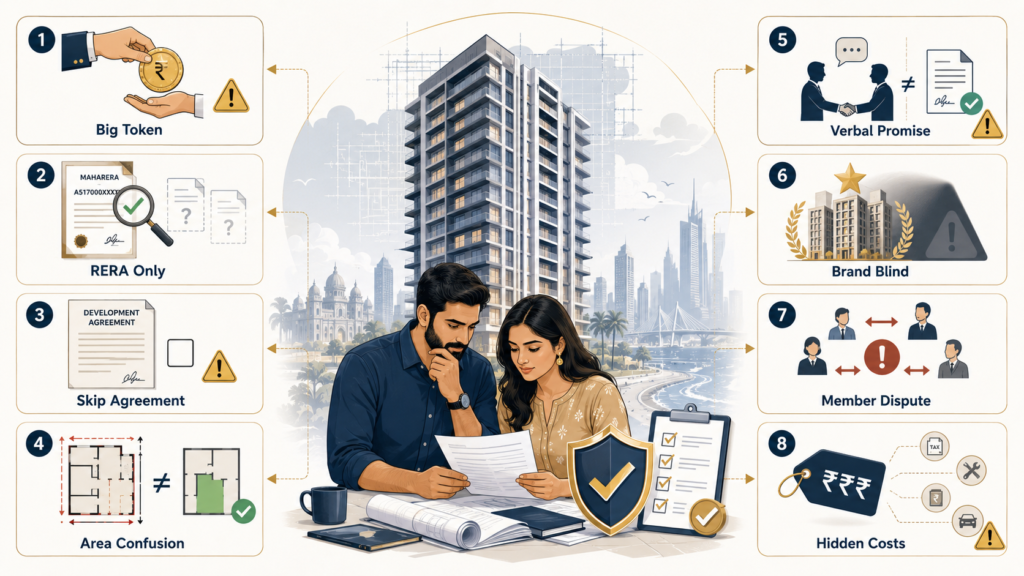
Paying a large token amount too early
A refundable token may still become difficult to recover when the refund terms are unclear.
Checking only the MahaRERA number
Registration is the beginning of due diligence, not the end.
Ignoring the Development Agreement
This document may determine whether the developer has the right to sell your flat.
Comparing saleable area instead of carpet area
A large quoted area may not mean more usable space.
Trusting oral possession promises
Only written, registered terms provide meaningful protection.
Assuming a famous developer means zero risk
Even established developers can face title, approval, contractor or society-related delays.
Ignoring existing-member disputes
A redevelopment project depends on more stakeholders than a normal development.
Focusing only on the base price
Hidden charges in redevelopment property transactions can materially increase the final budget.
Red Flags in Mumbai Redevelopment Projects
Pause the booking process when you notice:
- No valid MahaRERA number despite active marketing
- Different project names across documents
- A lapsed, revoked or abeyance project status
- Pressure to pay more than 10% before a registered agreement
- Refusal to provide the Development Agreement
- The flat is missing from the sanctioned plan
- Carpet area differs across documents
- Unclear landowner or society title
- Multiple unresolved mortgages
- Construction beyond the approved level
- Large delays in transit-rent payments
- Frequent changes in developers or contractors
- Pending insolvency proceedings
- An unrealistic possession date
- Major charges disclosed only after booking
- A cancellation clause with heavy buyer deductions
- Promised amenities missing from approved plans
Frequently Asked Questions
1. What should I check before buying a flat in a redevelopment project?
Check MahaRERA registration, land title, Development Agreement, society approval, developer authority, sanctioned plans, Commencement Certificate, carpet area, possession date, mortgages, litigation and the complete purchase cost.
2. How do I verify a redevelopment project in Mumbai?
Search the project on MahaRERA, verify the CTS and promoter details, review uploaded approvals and progress updates, inspect BMC permissions and ask a property lawyer to examine title and redevelopment documents.
3. Is it safe to buy a flat in a redevelopment project?
It can be safe when the legal title, society process, developer rights, MahaRERA registration, approvals, finances and sale agreement are properly verified. The category itself is not unsafe, but incomplete due diligence increases risk.
4. What is the free-sale component in redevelopment?
The free-sale component generally refers to apartments that the developer is permitted to sell in the open market to finance and earn from the redevelopment. Existing members receive their replacement premises through the rehabilitation component.
5. How do I check a redevelopment project on MahaRERA?
Search by project name, promoter or registration number. Match the project phase, CTS number, address, flat inventory, carpet area, approvals, completion date, quarterly updates and complaint history.
6. What approvals are required for redevelopment projects?
Requirements depend on the scheme and site. Common documents include sanctioned plans, IOD, Commencement Certificate, fire approvals and other authority permissions. An Occupancy Certificate is required at the completion stage for lawful occupation under applicable rules.
7. Should buyers hire a lawyer before booking a redevelopment flat?
Yes. An independent property lawyer can examine title, development rights, mortgages, litigation and agreement clauses. The developer’s lawyer represents the developer, not the buyer.
8. What happens if a redevelopment project is delayed?
Review the Agreement for Sale and MahaRERA completion date. Depending on the facts, RERA may provide remedies such as interest for delay or refund with applicable interest and compensation. Legal advice should be obtained for the specific case.
9. How can I verify carpet area before booking?
Match the carpet area on MahaRERA, the sanctioned plan, cost sheet, booking form and Agreement for Sale. Ask for a dimensioned floor plan and ensure balcony or terrace areas are shown separately.
10. Is GST payable on a redevelopment flat?
GST generally applies to under-construction sale flats according to the applicable residential-property category. The tax treatment may differ once the completion certificate or first occupation stage has been reached. Confirm the position with a tax professional.
11. Can I obtain a home loan for a redevelopment property in Mumbai?
Yes, subject to the lender’s approval of the borrower, developer, project documents, construction stage and proposed flat. Compare lenders because their project and disbursement requirements may differ.
12. How can I identify the best redevelopment projects in Mumbai?
There is no single best project for every buyer. Compare legal clarity, developer experience, construction progress, liveability, carpet efficiency, total cost, possession risk and location suitability.
13. What maintenance charges can apply after redevelopment?
Maintenance may cover security, lifts, common electricity, staff, parking systems, amenities, insurance and repairs. Ask for an estimated monthly rate, billing basis and advance-maintenance period before booking.
14. What is the biggest risk of buying a redevelopment flat?
The biggest risk is assuming that the sales brochure tells the complete story. Redevelopment projects may carry interconnected risks relating to title, society consent, development rights, rehabilitation obligations, approvals and finance.
Conclusion
Redevelopment apartments in Mumbai can provide modern homes in locations where new land is extremely limited. They may offer better layouts, new infrastructure and access to established neighbourhoods such as Khar.
However, buyers should not choose a project only because of its location, price, developer name or expected appreciation.
Before you Buy Properties in Mumbai, verify the project’s active MahaRERA status, the developer’s authority to sell, society documents, title, mortgages, approvals, carpet area, possession date and full cost.
A careful property inspection, independent legal opinion and properly drafted Agreement for Sale can help you buy a redevelopment flat in Mumbai safely and with greater clarity.
Planning to buy a redevelopment property in Khar or another prime Mumbai location?
A2Z Realtors can help you compare suitable redevelopment projects based on your preferred location, budget, carpet area, construction stage and possession needs.
Contact A2Z Realtors to shortlist verified options and arrange a project visit.
Disclaimer: This article provides general property-buying information and does not constitute legal, financial or tax advice. Buyers should obtain independent professional advice before entering into a transaction.