
Buying a home in Mumbai can be exciting, but it is also one of the largest financial decisions most people will ever make.
A buyer may spend weeks comparing locations, views, amenities and prices. Yet one overlooked approval, unclear agreement clause or unexpected charge can create years of financial stress.
The risk becomes higher when buyers compare redevelopment projects in Mumbai. These projects can provide new homes in established neighbourhoods such as Khar, Bandra, Santacruz, Juhu and Andheri. However, buyers must understand the developer’s rights, society arrangements, project approvals, construction stage and possession commitments before booking.
The safest approach is not to search only for the lowest price or the most attractive building. Instead, buyers should evaluate four things together:
- Whether the property meets their practical needs
- Whether the developer has the legal right to sell it
- Whether the project has the required approvals
- Whether the complete price and agreement terms are clear
This guide explains how to buy properties in Mumbai with greater confidence while avoiding common legal, financial and practical mistakes.
Important: This article provides general information. Property laws, tax treatment and project documentation can vary. Buyers should consult an independent property lawyer, chartered accountant and loan adviser before committing funds.
Table of Contents
- Quick answer: How can you buy property in Mumbai safely?
- Understand what type of property you are buying
- Set an all-inclusive budget
- Follow the three-gate property verification system
- Check the project on MahaRERA
- Complete legal due diligence
- Verify the developer’s redevelopment rights
- Check the builder’s credibility
- Verify the carpet area and layout
- Evaluate the location and site
- Review the complete cost sheet
- Check loan eligibility and project approval
- Review the agreement before paying
- Understand possession delays and buyer rights
- Inspect the property before possession
- Common mistakes Mumbai buyers make
- Redevelopment property buying checklist
- Frequently asked questions
- Conclusion
How Can You Buy Property in Mumbai Safely?
To buy property in Mumbai safely, first define your budget and housing needs. Next, verify the project on MahaRERA, examine the title and approvals, confirm the developer’s right to sell, compare the RERA carpet area and calculate the complete cost. Finally, ask an independent lawyer to review the agreement before making a major payment.
Under the Real Estate (Regulation and Development) Act, a promoter cannot accept more than 10% of the property cost as an advance or application fee without first entering into and registering an agreement for sale.
Understand What Type of Property You Are Buying
Not every Mumbai property follows the same verification process. Before comparing prices, identify the property category.
Ready-to-Move Property
A ready property is usually complete and available for physical inspection. Buyers should verify:
- Occupation Certificate
- Approved plan
- Title
- Existing mortgage
- Property tax payments
- Society records
- Maintenance dues
- Actual flat condition
The flat may be physically ready, but that does not automatically mean every approval is complete.
Resale Property
A resale transaction involves purchasing a home from an existing owner.
In addition to the building documents, check:
- Seller’s registered purchase agreement
- Share certificate
- Society registration details
- Maintenance payment receipts
- Property tax receipts
- Loan closure documents
- Bank NOC where applicable
- Seller’s authority to transfer the property
- Existing tenancy or occupancy claims
Under-Construction Property
Under-construction properties require additional attention because buyers are paying for a future home.
Verify:
- MahaRERA registration
- Declared completion date
- Approved building plan
- Commencement Certificate
- Construction progress
- Payment schedule
- Developer’s past delivery record
- Delay and refund clauses
Redevelopment Property in Mumbai
A redevelopment property in Mumbai is generally a new apartment constructed after an older building or housing society is demolished and rebuilt.
Existing occupants may receive replacement homes. The developer may obtain the right to construct and sell additional apartments to outside buyers. These additional saleable apartments are commonly described as the free-sale component.
Buyers researching property redevelopment in Mumbai may come across:
- Society redevelopment projects in Mumbai
- Private building redevelopment
- MHADA redevelopment
- Cessed-building redevelopment
- Cluster redevelopment
- Rehabilitation-linked projects
- Residential redevelopment projects Mumbai
- Under-construction redevelopment projects Mumbai
Each category may involve different ownership records, approvals and stakeholder arrangements. Therefore, buyers should not treat all redevelopment real estate Mumbai inventory as legally identical.
Do Not Search for the “Best Project” Before Defining Your Requirements
Many buyers start by searching for the best redevelopment projects in Mumbai or the cheapest homes in a preferred location. This approach can create confusion because “best” depends on the buyer.
Before beginning site visits, write down:
- Maximum all-inclusive budget
- Comfortable home-loan EMI
- Minimum carpet area
- Required number of bedrooms
- Preferred possession period
- Daily commuting needs
- School and healthcare requirements
- Parking requirement
- Floor preference
- Need for amenities
- Expected length of ownership
- Risk tolerance for under-construction property
For example, a larger under-construction flat may look attractive, but it may not suit a family that needs to move within six months. Similarly, a premium address may not be worthwhile if the EMI leaves no emergency savings.
A suitable property is one that remains practical after the excitement of the site visit has passed.
Create an All-Inclusive Property Budget
The advertised price is rarely the final amount a buyer pays.
Your property budget should include:
| Cost component | What to verify |
|---|---|
| Base property price | Whether it is calculated on RERA carpet area |
| Stamp duty | Current amount based on applicable state rules |
| Registration fee | Current government registration charge |
| GST | Whether the transaction attracts GST |
| Floor-rise charge | Additional cost for higher floors |
| Parking | Type, allocation and written terms |
| Maintenance deposit | Amount, purpose and covered period |
| Advance maintenance | Start date and monthly rate |
| Club or amenity charges | Mandatory or optional |
| Utility deposits | Electricity, water and gas |
| Legal and documentation charges | Exact service being provided |
| Brokerage | Amount, tax and payment stage |
| Loan expenses | Processing, valuation and legal fees |
| Interior work | Post-possession furnishing cost |
| Moving expenses | Temporary stay, storage and relocation |
The Maharashtra Department of Registration and Stamps provides official property-valuation, stamp-duty and registration services. Buyers should use the current official calculator instead of depending on an old percentage quoted in an advertisement or social-media post.
GST on Redevelopment Flats in Mumbai
For residential projects commencing under the post-April 2019 framework, official GST guidance provides an effective rate of 1% without input tax credit for qualifying affordable residential apartments and 5% without input tax credit for other residential apartments. The exact treatment depends on the project, transaction date, apartment category and completion status.
Generally, construction intended for sale is treated differently when the entire consideration is received after the applicable completion certificate or first occupation. Buyers should obtain written tax clarification from the developer and confirm it with a chartered accountant.
Do not accept a simple statement such as “GST is included” without asking for:
- Taxable value
- GST rate
- GST amount
- Developer’s GST details
- Payment stage
- Proper tax invoice
- Treatment of additional charges
The Three-Gate Property Verification System
Before booking a property, pass it through three decision gates.
Gate 1: Practical Suitability
Ask whether the home fits your real life.
Review:
- Travel time during peak hours
- Road and railway access
- Noise levels
- Natural light
- Ventilation
- Room dimensions
- Storage space
- Parking access
- Building entrance
- Lift capacity
- Monthly maintenance
- Nearby construction
- Future family requirements
Gate 2: Legal and Approval Suitability
Confirm:
- Clear title
- Development rights
- Right to sell the selected unit
- MahaRERA registration
- Correct project phase
- Sanctioned plan
- Commencement Certificate
- Disclosed mortgages
- Society approvals
- Litigation status
Gate 3: Financial and Contractual Suitability
Review:
- All-inclusive price
- Payment schedule
- Loan approval
- Possession date
- Grace period
- Delay compensation
- Cancellation terms
- Refund clause
- Maintenance charges
- Tax liability
- Parking terms
- Written amenity commitments
A property should pass all three gates. A good location cannot correct an unclear title, and a clear title cannot make an unaffordable EMI practical.
How to Check a Redevelopment Project on MahaRERA
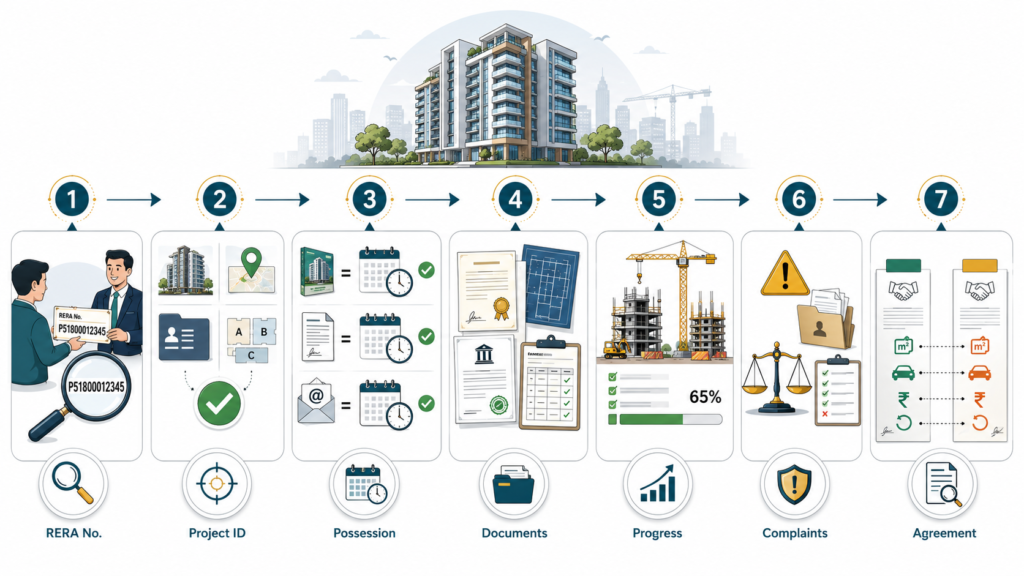
MahaRERA registration is an essential verification step for applicable projects, but registration alone should not be treated as a complete legal guarantee.
The official MahaRERA website allows buyers to search registered projects and access separate information relating to complaints, lapsed projects, revoked registrations, quarterly-progress non-compliance, common-bank-account issues, NCLT projects and deregistered projects.
Step 1: Obtain the Exact Registration Number
Ask the salesperson for the project’s MahaRERA number.
Do not rely only on:
- Project name
- Developer’s brand name
- Brochure logo
- Registration number of another wing
- Registration number of an earlier phase
Step 2: Match the Project Identity
Check:
- Promoter’s legal name
- Project name
- Address
- District
- Registered phase
- Building or wing
- Registration status
- Declared completion date
RERA registered redevelopment projects in Mumbai may be divided into separate phases. Therefore, confirm that the registration applies to the building and unit you are considering.
Step 3: Check the Declared Possession Date
Compare the date shown on MahaRERA with the date stated in:
- Brochure
- Cost sheet
- Booking form
- Allotment letter
- Draft agreement
- Email from the sales team
A mismatch requires written clarification.
Step 4: Review Uploaded Documents
Depending on what is available for the project, review:
- Registration certificate
- Title report
- Approved plans
- Commencement Certificate
- Draft agreement
- Project details
- Inventory information
- Extension records
- Construction updates
The RERA Act requires registration applications to include information such as approvals, commencement certificates, carpet areas, title-related declarations and project details.
Step 5: Examine Construction Updates
Compare the reported progress with what you observe during the site visit.
Look for:
- Long periods without progress
- Construction stage inconsistent with payment demands
- Outdated project updates
- Frequent changes to completion dates
- Extension applications
- Missing approval updates
Step 6: Search for Complaints and Regulatory Issues
MahaRERA provides project-wise and promoter-wise complaint information, along with non-compliance and regulatory project lists.
A complaint does not automatically prove that a project is unsafe. However, buyers should understand:
- Nature of the complaint
- Number of complaints
- Whether the issue is repeated
- Status of the matter
- Final order, where available
- Whether the promoter complied with the order
Step 7: Compare the Draft Agreement
Compare the draft uploaded on MahaRERA with the agreement presented to you.
Check for changes relating to:
- Carpet area
- Possession
- Payment schedule
- Amenities
- Parking
- Cancellation
- Refunds
- Delay interest
- Additional charges
This is a practical MahaRERA checklist for redevelopment property buyers.
Legal Checks Before Buying a Flat in Mumbai
Proper property due diligence in Mumbai involves more than viewing one certificate.
The exact documents depend on whether the property is ready, resale, under construction, society redevelopment, MHADA redevelopment or another project type.
1. Title Documents
Ask an independent property lawyer to review:
- Property card
- Conveyance deed
- Deemed conveyance order, where applicable
- Title certificate
- Title search report
- Ownership-chain documents
- Relevant land records
- Disclosed encumbrances
- Pending title disputes
A promoter’s lawyer may issue a title report, but your lawyer should review it independently.
2. Development Agreement
In redevelopment, the development agreement establishes the relationship between the society or landowner and the developer.
It should clarify:
- Developer’s appointment
- Development rights
- Authority to obtain approvals
- Right to construct
- Right to sell free-sale apartments
- Project responsibilities
- Timelines
- Termination provisions
- Financial obligations toward the society
The MahaRERA model agreement contemplates that the promoter’s right to sell may arise through a development agreement or power of attorney and that relevant title and approved-plan records should be available for inspection.
3. Power of Attorney
Check whether the society or landowner has authorised the developer to:
- Apply for approvals
- Sign documents
- Construct the project
- Market units
- Execute sale agreements
- Receive consideration
The power must cover the selected transaction.
4. Society Records
For society redevelopment projects in Mumbai, relevant records may include:
- Society registration certificate
- General body resolutions
- Developer appointment resolution
- Member-consent records
- Conveyance or deemed conveyance
- Registered development agreement
- Dispute records
Your lawyer should determine which records are material for the specific project.
5. Sanctioned Building Plan
Confirm that the approved plan includes:
- Correct building
- Correct wing
- Relevant floor
- Selected flat
- Balconies and terraces
- Parking arrangement
- Amenities being promised
- Access and common areas
Do not assume that a floor shown in a brochure has received approval.
6. Commencement Certificate
A Commencement Certificate allows construction according to the approved scope.
Check whether it covers the construction stage and floor connected to the unit you are buying.
An approval to begin lower-floor work does not automatically confirm permission to construct every advertised upper floor.
7. Mortgage and Lender Records
Ask:
- Has the land been mortgaged?
- Have project receivables been assigned?
- Does the lender permit the sale?
- Is a unit-level NOC required?
- How will the flat be released from the charge?
- Where should payments be deposited?
A mortgage is not automatically a reason to reject a project. However, the sale and release procedure must be documented.
8. Litigation and Insolvency Search
Your lawyer may need to examine:
- MahaRERA complaints
- Consumer disputes
- Civil litigation
- Society disputes
- Title disputes
- NCLT or insolvency matters
- Regulatory restrictions
- Orders affecting construction or sales
These are among the most important documents to check before buying a flat in Mumbai.
What Is the Free-Sale Component in Redevelopment?
In many redevelopment arrangements, existing occupants receive replacement premises. The developer may be permitted to construct additional apartments that can be sold to outside buyers.
These saleable units are commonly called the free-sale component.
Before purchasing one, confirm:
- The development agreement gives the developer the right to sell it.
- The flat appears in the approved plan.
- Construction approval covers the relevant floor.
- The correct phase is registered with MahaRERA.
- The unit is not already allotted, sold or improperly charged.
- Any project lender has approved the sale where required.
- Your agreement identifies the correct flat, floor, wing and carpet area.
This is especially important when buyers compare new redevelopment projects in Mumbai or MahaRERA redevelopment projects based only on advertisements.
How to Verify the Builder’s Track Record
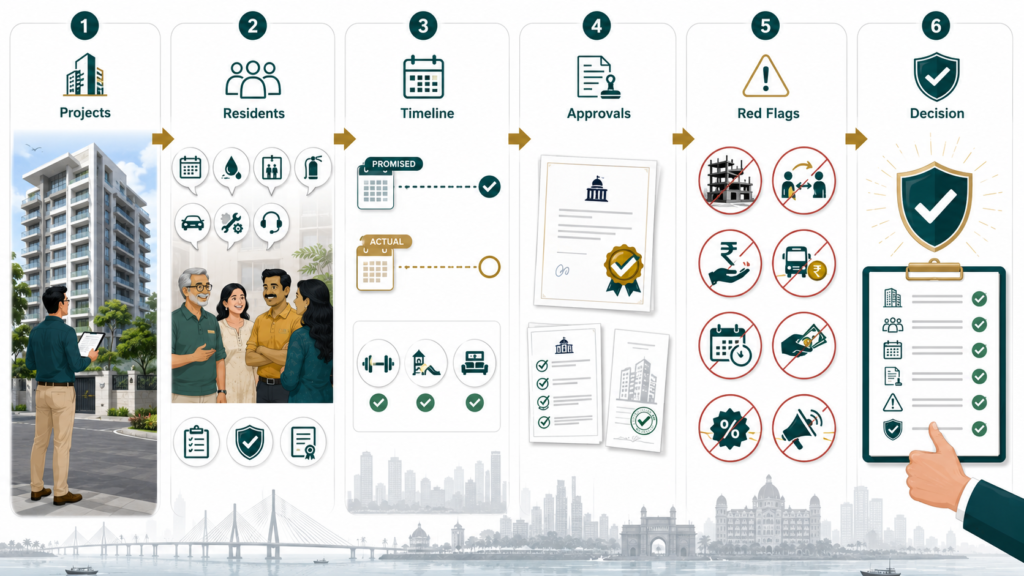
A famous brand name does not remove the need for developer due diligence for redevelopment property.
Visit Completed Projects
Visit at least one completed building by the same developer.
Speak with residents about:
- Actual possession date
- Construction quality
- Leakage
- Lift performance
- Fire-safety systems
- Parking
- Maintenance
- Customer service
- Defect rectification
- Occupation Certificate
Compare Declared and Actual Delivery
Review earlier project timelines.
Ask:
- Were previous projects delivered on time?
- Were extensions obtained?
- Did buyers receive possession without major disputes?
- Were common amenities completed?
- Did the developer obtain the required completion or occupation approvals?
Look for Financial Warning Signs
Possible warning signals include:
- Construction stopping for long periods
- Frequent contractor changes
- Several unfinished projects
- Delayed payments to society members
- Complaints about unpaid transit rent
- Repeated extension requests
- Heavy pressure for early payments
- Discounting that appears inconsistent with the market
One warning sign may have a reasonable explanation. Several connected warning signs require deeper investigation.
How to Verify Carpet Area Before Booking a Flat
The RERA definition of carpet area refers to the net usable floor area of an apartment. It excludes external walls, service shafts, exclusive balconies, verandahs and open terraces, while including internal partition walls.
Compare the carpet area across:
- MahaRERA record
- Cost sheet
- Floor plan
- Booking form
- Allotment letter
- Agreement for sale
- Architect’s plan
Avoid relying only on terms such as:
- Saleable area
- Super built-up area
- Approximate usable area
- Chargeable area
Practical Carpet-Area Example
Suppose you compare two redevelopment apartments in Mumbai:
- Flat A: 735 sq. ft. RERA carpet area
- Flat B: 770 sq. ft. RERA carpet area
Flat B appears larger. However, it may have a long passage, large internal wall area or awkward columns.
Also compare:
- Living-room width
- Bedroom dimensions
- Kitchen layout
- Storage
- Passage space
- Window placement
- Column positions
- Natural light
- Ventilation
A higher carpet-area number does not always mean a better layout.
Evaluate the Khar Location Beyond the Pin Code
A Khar address may be desirable, but buyers should evaluate the exact building and street rather than relying on the neighbourhood name.
Visit the site:
- During morning traffic
- During evening traffic
- On a weekend
- During the monsoon where possible
- After dark
- During active construction hours
Check:
- Road width
- Entry and exit
- Noise
- Waterlogging
- Parking congestion
- Nearby commercial activity
- Access for emergency vehicles
- Distance from regular transport
- Neighbouring redevelopment
- Construction dust
- Privacy
- Future obstruction of views
Be Careful When Paying for an “Open View”
In built-up Mumbai neighbourhoods, a nearby low-rise building may later undergo redevelopment.
Before paying a large view premium, ask:
- Who owns the adjacent plot?
- Is another redevelopment proposal expected?
- Can an additional wing be constructed?
- Is the view protected by a public road, reserved land or another lasting feature?
- Are all advertised floors approved?
Treat a view as permanent only when there is reliable evidence supporting that assumption.
Hidden Charges in Redevelopment Property Mumbai Buyers Should Question
Ask the developer to explain every cost-sheet line.
Question unclear descriptions such as:
- Administrative charges
- Facilitation charges
- Infrastructure charges
- Development charges
- Documentation charges
- Possession charges
- Corpus-related charges
- Society formation charges
- Legal fees
- Other charges
Ask:
- Is the charge compulsory?
- What service does it cover?
- Is GST added?
- Is it refundable?
- When is it payable?
- Does it appear in the agreement?
- Can the amount increase later?
The cost of buying a redevelopment flat in Mumbai should be evaluated using the final payable amount—not merely the advertised base price.
Home Loan for Redevelopment Property Mumbai Buyers
A bank may finance a redevelopment property after reviewing the borrower and project. However, project approval by a bank does not replace independent legal due diligence.
A lender’s review protects the lender’s financing decision. Your lawyer’s review protects your ownership interests.
Before depending on a home loan, confirm:
- Whether the project is approved by your preferred bank
- Whether your selected unit is financeable
- Maximum loan-to-value ratio
- Required buyer contribution
- Disbursement stages
- Pre-EMI implications
- Processing and legal fees
- Rate-reset conditions
- Consequences of construction delay
- Lender NOC requirements
- Loan cancellation implications
“Bank approved redevelopment projects in Mumbai” can be a useful filtering criterion, but it should never be treated as proof that the project has no legal, commercial or construction risk.
Review the Agreement Before Making a Major Payment
The agreement for sale is not a routine formality. It is the central contract governing the purchase.
Under RERA, a promoter cannot take more than 10% before entering into and registering the agreement for sale. The agreement should address development particulars, payment dates, possession and applicable interest in case of default.
Ask your lawyer to check:
- Buyer and promoter details
- Flat number
- Floor
- Wing
- RERA registration number
- RERA carpet area
- Total consideration
- Payment schedule
- Taxes
- Parking
- Possession date
- Grace period
- Delay compensation
- Refund terms
- Cancellation deductions
- Force-majeure clause
- Area-variation clause
- Amenities
- Specifications
- Maintenance
- Defect liability
- Dispute-resolution process
- Promoter’s title representations
- Disclosed mortgages
- Disclosed litigation
The MahaRERA model agreement contains representations relating to title, development rights, approvals, encumbrances and disclosed litigation. Buyers should ensure that the final agreement accurately reflects the specific project and transaction.
What Happens If a Redevelopment Project Is Delayed?
First compare the actual progress with:
- Agreement possession date
- MahaRERA completion date
- Approved extensions
- Written developer communication
- Payment progress
Under Section 18 of the RERA Act, when a promoter fails to complete or provide possession according to the agreement, an allottee who withdraws may seek return of the amount with prescribed interest and applicable compensation. An allottee who remains in the project may be entitled to prescribed interest for the delay until possession. The remedy depends on the facts, agreement and applicable proceedings.
Do not wait until a delay occurs to examine:
- Grace-period wording
- Extension clauses
- Refund procedure
- Interest provisions
- Cancellation deductions
- Dispute jurisdiction
Inspect the Flat Before Accepting Possession
Before accepting possession, verify:
- Occupation Certificate for the relevant building or part
- Water connection
- Electricity connection
- Lift operation
- Fire-safety systems
- Parking
- Entrance and common areas
- Flat dimensions
- Doors and windows
- Plumbing
- Electrical points
- Flooring
- Leakage
- Wall cracks
- Drainage slopes
- Promised fixtures
- Amenity completion
Prepare a written snag list with photographs and dates.
RERA provides that structural defects and certain defects in workmanship, quality, services or promoter obligations reported within five years from possession must be rectified without further charge within the statutory period stated in the Act; failure may support a claim for compensation.
Common Mistakes Buyers Make in Mumbai
| Mistake | Possible consequence | Better approach |
|---|---|---|
| Choosing only by location | Legal or approval risks remain hidden | Complete title and approval checks |
| Relying only on MahaRERA registration | Important project-specific risks may be missed | Review uploaded records, complaints and agreement |
| Comparing only price per sq. ft. | Different area definitions create false comparisons | Compare price using RERA carpet area |
| Booking an unapproved floor | Possession or approval problems | Check plan and Commencement Certificate |
| Trusting verbal promises | Amenities or charges may later change | Obtain every promise in writing |
| Ignoring the project phase | Registration may apply to another wing | Match the exact phase and unit |
| Treating bank approval as a guarantee | Bank and buyer risks are not identical | Conduct independent legal review |
| Paying before reviewing the agreement | Buyer loses negotiating power | Review first and follow the statutory payment process |
| Ignoring maintenance | Monthly ownership cost becomes unaffordable | Obtain an estimated maintenance schedule |
| Paying for a view without checking nearby plots | View may later be blocked | Investigate surrounding development potential |
| Stretching the EMI | No emergency financial buffer | Set a practical all-inclusive budget |
| Assuming a known builder cannot face delays | Brand reputation is not project-specific proof | Review project-level performance |
Redevelopment Property Buying Checklist in Mumbai
Before you buy a flat in a redevelopment project Mumbai buyers should complete the following checks:
Buyer and Budget
- Maximum all-inclusive budget is fixed
- EMI remains affordable
- Emergency savings remain available
- Possession timeline fits the family’s needs
Project Identity
- Correct project name
- Correct promoter
- Correct MahaRERA number
- Correct phase, wing and building
- Correct unit and floor
Legal Rights
- Title reviewed
- Development agreement reviewed
- Power of attorney reviewed
- Developer’s right to sell confirmed
- Free-sale status confirmed
- Mortgage and lender conditions checked
- Litigation search completed
Approvals
- Sanctioned plan checked
- Selected flat appears in the plan
- Commencement Certificate covers the relevant stage
- MahaRERA documents reviewed
- Regulatory and complaint lists checked
Commercial Terms
- RERA carpet area confirmed
- Complete cost sheet obtained
- GST treatment confirmed
- Stamp duty checked through the current official system
- Parking recorded in writing
- Maintenance charges estimated
- Hidden charges questioned
Agreement and Payment
- Lawyer reviewed the agreement
- Possession date matches MahaRERA
- Delay and refund clauses reviewed
- Cancellation terms understood
- Payment goes to the correct account
- All receipts will be retained
This legal checklist for redevelopment property buyers cannot remove every risk, but it can help identify major concerns before a large payment is made.
Frequently Asked Questions
1. What to check before buying a flat in a redevelopment project?
Check the land title, development agreement, developer’s right to sell, sanctioned plan, Commencement Certificate, MahaRERA details, carpet area, construction stage, possession date, total cost and agreement terms.
2. Is it safe to buy a flat in a redevelopment project?
It can be safe when the project has clear development rights, valid approvals, transparent pricing and a credible promoter. The main risks of buying flat in redevelopment project include title disputes, society disagreements, approval delays, weak finances, construction delays and unauthorised units.
3. How to verify a redevelopment project in Mumbai?
Obtain the MahaRERA number, search the correct project and phase, review uploaded records, compare the possession date, examine construction updates, check complaints and ask a lawyer to review the title and agreement.
4. How to check a redevelopment project on MahaRERA?
Search by registration number, project name or promoter. Match the promoter, location, phase and completion date. Then review the available documents, progress updates, extensions, complaints and non-compliance lists.
5. What documents are required before buying a redevelopment flat?
Documents required before buying redevelopment flat inventory may include the title report, property card, conveyance records, development agreement, power of attorney, society resolutions, sanctioned plan, Commencement Certificate, MahaRERA certificate, mortgage details and agreement for sale.
6. What are the main red flags in Mumbai redevelopment projects?
Common red flags include pressure to pay quickly, unclear sale rights, changing possession dates, unapproved floors, missing documents, outdated construction updates, unexplained charges, repeated delays and unresolved society disputes.
7. How to verify builder track record before buying a flat?
Visit completed projects, speak with residents, compare promised and actual delivery dates, review Occupation Certificates, search MahaRERA complaints and examine the developer’s incomplete projects.
8. How to check builder credibility in Mumbai redevelopment?
Complete developer due diligence for redevelopment property by reviewing the builder’s delivery history, quality, customer service, litigation, financial warning signs and performance in previous society redevelopment projects.
9. What documents to check in redevelopment project Mumbai buyers should prioritise?
Prioritise the title report, development agreement, power of attorney, sanctioned plan, Commencement Certificate, MahaRERA details, lender NOC where applicable and registered agreement for sale.
10. What hidden charges in redevelopment property Mumbai buyers may face?
Possible charges include floor rise, parking, maintenance deposits, advance maintenance, club charges, legal fees, utility deposits, administrative charges, infrastructure charges and brokerage. Ask for a written, itemised cost sheet.
Conclusion
Buying property in Mumbai should never be reduced to choosing a location, comparing a brochure and negotiating the price.
A safe buying decision requires several connected checks:
- Does the home suit your budget and daily life?
- Does the seller have a clear legal right to sell it?
- Is the selected unit included in the approved project?
- Does the MahaRERA information match the sales documents?
- Is the RERA carpet area consistent?
- Is the complete cost affordable?
- Does the agreement protect your interests?
- Is the possession timeline realistic?
This is especially important when comparing redevelopment flats for sale in Mumbai. A newly constructed building in a prime location may offer excellent potential, but only when the title, approvals, developer rights and commercial terms remain clear.
Planning to properties Consultants in Mumbai, explore homes in Khar or compare RERA registered redevelopment projects in Mumbai?
A2Z Realtors can help you shortlist properties based on your budget, preferred carpet area, location, construction stage and possession needs. The team can also help coordinate project comparisons, site visits and document collection for your independent professional review.
Contact A2Z Realtors to explore suitable properties in Khar and other prime Mumbai locations.